4. Third phase: Identifying interventions
The third phase of the WEFe Framework 2.0, the identifying intervention phase, is focused on identifying technical, organizational and/or governance-related interventions to address the WEFe nexus problem diagnosed in previous phases (i.e., the undesirable state of water, energy, ecosystems, and/ or food production). As one of the main tasks of the WEFe Framework 2.0, this phase is crucial for developing actionable solutions.
There are three different methodological approaches to identify and shortlist interventions, which can be selected depending on personnel and financial resources, time, risk of stakeholder fatigue, etc. These approaches are:



Note: Option A is the most time- and resource-intensive, but it has the advantage of the highest stakeholder legitimacy, followed by Option B, and finally Option C.
 Definitions interventions
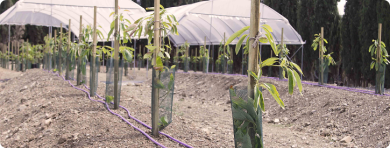
In the context of the WEFe Framework, interventions are understood as local technical or organizational intervention, or a combination of both, aimed at improving the WEFe nexus. Technical interventions include, for example, solar irrigation, wastewater reuse, nature-based solutions (NBS), or energy-exporting solar greenhouses. Organizational interventions include, for example, payments for ecosystem services or command and control measures.
Interventions for agricultural water use: drip irrigation, treatment of wastewater, desalination, rainwater harvesting, hydroponics, energy efficiency technology, solar irrigation systems, ecological pond management, fertigation, solar-driven on-farm desalination plant for saline groundwater, constructed wetlands, …
Interventions for energy use in agriculture: photovoltaics, energy storage, geothermal energy production, …
Innovative farming practices: fertilizer reduction, no-tillage, crop rotation, cover crops, integrated pest management, fertilization with sewage sludge, integrating livestock and crops, agroforestry, soil conservation measures, integrating livestock and crops, or sharecropping arrangements.
How many interventions are to be identified?
If time and resources permit, 2-4 interventions should be identified to address the WEFe nexus problem, which can be either complementary or alternative to each other.
Note: Due to the complexity of the issue, it is unlikely that a single intervention will fully resolve the problem. For example, to address water scarcity, the use of treated wastewater may be combined with solar energy; or, in the case of soild degradation, sustainable farming practices may be combined with rainwater harvesting.

.png)