
1.4. Getting familiar with the WEFe Nexus approach
The WEFe nexus approach is a concept that highlights the interconnections and interdependencies between four nexus components: water, energy, food, and ecosystems.
It emphasizes that these systems are deeply linked, and changes or decisions in one component can have significant impacts on the others.
The WEFe Nexus concept, originating in Western policy frameworks, offers a systems-based approach to managing interconnected resources.
However, it is top-down, and its technical nature often overlooks local knowledge, socio-cultural contexts, and stakeholder perceptions. In many regions, the WEFe nexus is not understood by key actors and local communities in the same way, thus challenging the operability of the WEFe nexus thinking and application (Albrecht et al. 2018, McGrane et al. 2018). This highlights the need for more inclusive, context-sensitive approaches that integrate local perspectives and knowledge in WEFe decision-making.
The WEFe nexus approach is designed to guide integrated management and policy-making to address challenges related to WEFe sustainability, resource use, and environmental protection. Here’s a breakdown of what the WEFE nexus thinking is about (see also Figure 1.2):
.png)
Ecosystem is the most crucial WEFe component as it supports the other three components:
- Helps regulate water cycles, maintain biodiversity, and contribute to soil fertility (all of which are essential for food production).
- They also provide additional ecosystem services that energy systems may depend on, such as hydrological cycles that support hydroelectric power generation.

Water is essential for:
- Food production, energy generation, as well as for ecosystems.
- Agriculture and energy systems, such as hydropower or cooling in thermal power plants, rely heavily on water resources.
Efficient management of the WEFe water resources is crucial for ensuring that all WEFe sectors have enough access to this vital resource.

Energy is required to extract, process, and distribute both water and food:
- The production of food often involves significant energy input (e.g., for irrigation, processing, and transportation).
- In turn, energy systems themselves rely on water resources (e.g., for cooling in power plants or for hydropower generation).
- Thus, optimising energy use and shifting to sustainable energy sources is essential to minimising negative impacts on water resources.

Food production is heavily dependent on water, energy, and ecosystems:
- Irrigation systems, fertilizers, and machinery all require water and energy.
- Land and ecosystems provide the natural resources for growing food.
- Agriculture must be managed in ways that conserve these resources and minimize environmental damage (such as reducing the impact on water quality or ecosystems).
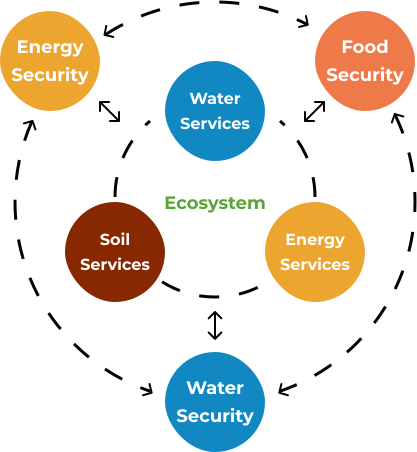
The WEFe nexus thinking is thus an integrated approach to managing the interconnections among water, food, energy, and ecosystems to optimize resource use, minimize trade-offs and identify mismatch to ensure WEFe nexus sustainability. It emphasizes holistic decision-making by recognizing that actions in one component impact the others. Despite its complexity and governance challenges, WEFe nexus thinking is crucial for creating resilient and sustainable systems that balance human and environmental needs.
Analysing WEFe nexus trade-offs and mismatches for sustainability
The analysis of trade-offs and mismatches within the WEFe nexus (water, energy, food, ecosystems) is crucial for sustainability, as it helps balance competing demands and limited resources across sectors. Understanding these impacts allows for more sustainable solutions.

Examples of trade-offs include:
- Irrigation for agriculture competing with potable water or industrial needs.
- The growing demand for biofuels competing with food production for land and water.
- Thermal power plants and hydropower that consume large amounts of water, competing with agricultural needs.
- Ecosystem degradation, which affects all sectors (water, energy, food).
Many mismatches occur which may lead to conflicts and inefficiencies in resource management
- Because stakeholders often overlook the importance of ecosystems (Albrecht, Crootof, and Scott 2018)
- Have a limited understanding of the water cycle (Bidoglio et al. 2019)
Protecting ecosystems is critical, as they provide essential services like water regulation, soil fertility and biodiversity. Which support the other three components of the WEFe nexus. By addressing these trade-offs and mismatches, more integrated and sustainable resource management approaches can be developed.
 Definitions WEFe nexus
The Water-Energy-Food-Ecosystems (WEFe) Nexus refers to the biophysical interdependencies (i.e., trade-offs and synergies) between the use and production of water, energy, and land resources, the production of food and protection of ecosystems. These interdependencies are associated with a particular practice of resource users (e.g., use of desalinated water which has implications for water, energy, and ecosystems) and are a fact of life. The nexus as such does not tell us how to govern or address them best.
WEFe nexus Trade-offs refer to situations where an action targeting one component of the WEFE nexus—water, energy, food, or ecosystems—has a direct impact on another component, either decreasing (trade-off) or increasing (synergy) the benefits it provides. These trade-offs arise from the interdependencies and interactions between the four systems, highlighting the challenge of optimizing one without causing adverse effects on the others.
A WEFe mismatch occurs when the interconnected demands and supplies of the WEFe components (water, food, energy, and ecosystem) are misaligned with the perceptions and preferences of actors involved in decision making, leading to inefficiencies, resource conflicts, and environmental degradation. This concept reflects the challenges of managing the WEFe components in an integrated and sustainable way, especially in the face of growing populations, climate change, and competing land use demands.