
5. Fourth phase: Assessment phase
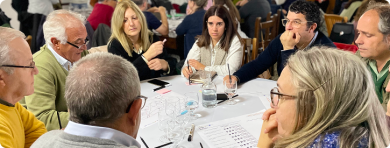
The fourth phase of the WEFe Framework 2.0, the assessment phase, is the most extensive phase, offering an in-depth analysis of the interventions that have been identified in the previous phase. In this phase, the interventions and their potential to improve the nexus will be evaluated first using a desk-based analysis and then through a participatory approach.
.svg) Optional Pathways
Optional Pathways
Desk-based performance assessment
The bundle(s) of interventions identified in the previous phase will be assessed in terms of their potential to solve the WEFe nexus problems of the focal area. Thereby, it shall be ensured that the selected interventions are able to address the specific problem, i.e., that they help to reduce the use of water, energy or land and protect ecosystems, while ensuring that food production and local livelihoods are maintained or improved. This also means that trade-offs and synergies need to be considered. These two tools analyze “what if” scenarios, showing the potential impact of the interventions, combinations of interventions, or different implementation levels.
To undertake this desk-based assessment, two methods can be used:

First, the REWEFe (Rapid Evaluation of the Water, Energy, Food and ecosystem) will be used to model scenarios on the impact of interventions on the WEFe nexus.

Second, the Cost-Benefit Analysis allows evaluation of the economic advantages and disadvantages of the selected intervention.
 Definition performance assessment
In the context of the WEFe Framework, the performance of an intervention relates to how well it contributes to solving the WEFe nexus problem. This means whether the intervention helps to balance the use of water, energy and land, and protect ecosystems, while ensuring that food production and local livelihoods are maintained or improved (i.e., creating synergies). The performance refers to the ability of an intervention to achieve improvements across multiple interrelated indicators, considering the complexity of managing the interconnected resources, and ecosystem boundaries.
Quick links
A user-friendly tool to model WEFe scenarios, balancing simplicity with broad applicability.
A systematic process used to evaluate the economic advantages and disadvantages of a project or decision.
More detailed information and supporting materials on how the tool works